

Picture this: your Spanish ad runs in Miami, Mexico City, and Madrid. Same words, same smiling stock photo. Miami scrolls past. Mexico City finds the wording a little stiff. Madrid winces at a word that means something else there. One language, three audiences, zero connection.
That’s the gap hyper localization (also written hyperlocalization) fills. Hyper localization means adapting content not just for a country or language but for a specific region, city or audience segment inside it, using local slang, references, imagery, and offers. It goes one step past localization, and it works best when you have data on that audience and a market big enough to justify the extra versions.
In this guide, we’ll show the same line of ad copy at three levels, share real examples, and give you a quick test to decide if it’s worth it. The goal is simple: make content feel local, down to the neighborhood.
TL;DR
- Hyperlocalization adapts content for a city, region, or audience segment, not just a country or language.
- It goes one step past localization: think local slang, regional dialect, local holidays, local imagery, and local payment methods.
- It’s not the same as hyperlocal marketing, which is about getting foot traffic to a nearby store.
- It pays off when you have customer data on the segment and a market big enough to justify extra versions.
- Start small: 1-2 regions, a few key assets, transcreation, then A/B testing.
What Is Hyper Localization (aka Hyperlocalization)?
Hyper localization is localization with a zoom lens. Standard localization adapts content for a country and its language. Hyperlocalization adapts it for a smaller slice of that country: a city, a region, or a defined audience segment.
That means you change more than words. You swap in regional dialect and slang, reference local culture and sports teams, plan around local holidays, use local imagery, and offer the payment methods people there actually use.
Why bother? Language alone already moves the needle. A 2020 CSA Research survey of 8,709 consumers in 29 countries found that 76% prefer product info in their own language, 65% prefer their language even if quality is poor, and 40% never buy from sites in other languages. Hyper localization takes that same instinct one step further. If people prefer their own language, they light up when they hear their own city in it. So you move from one country-wide message to city-level content that sounds like home.
It builds on solid localization services, not instead of them. You need a strong country version first, then you sharpen it for each segment.
Translation vs Localization vs Hyper Localization: One Line, Three Levels
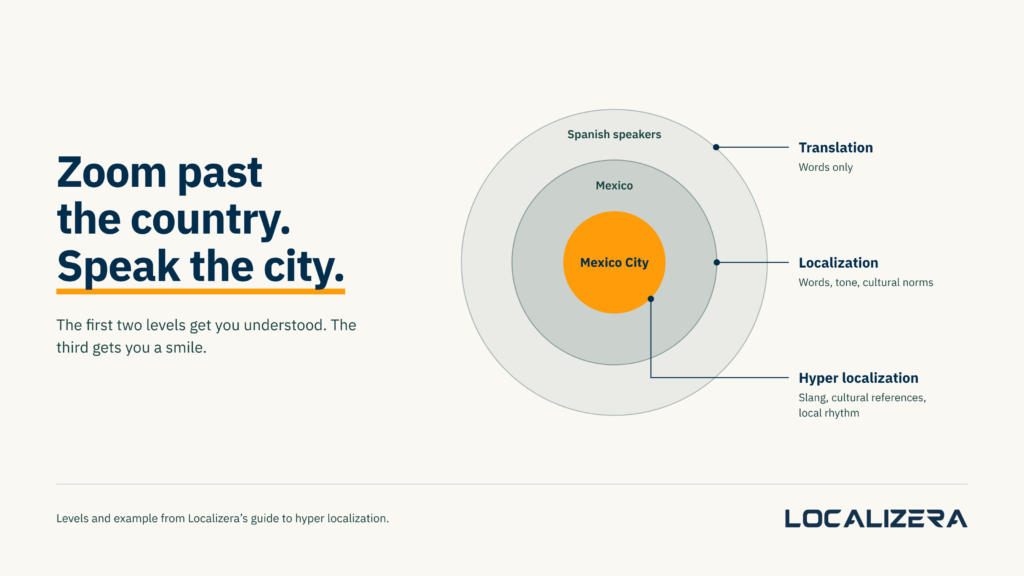
The easiest way to see the difference is to watch one line of ad copy travel. Our English source line for a food delivery app: “Lunch is on us this Friday.”
|
Level |
Who it targets |
What changes |
Spanish version (and what it says) |
|---|---|---|---|
|
Translation |
“Spanish speakers” |
Words only |
“El almuerzo corre por nuestra cuenta este viernes.” Correct, but it sounds like a textbook. |
|
Localization |
A country (Mexico) |
Words, tone, cultural norms |
“Este viernes, la comida va por nuestra cuenta.” In Mexico, comida is the midday meal, so it lands naturally. |
|
Hyper localization |
A city (Mexico City, Madrid, Miami) |
Slang, cultural references, local rhythm |
See below. |
Here’s the hyper-local step, one city at a time:
- Mexico City: “¿Viernes de chamba? La comida va por nuestra cuenta.” (Chamba is everyday slang for work.)
- Madrid: “¿Viernes de curro? Hoy invitamos a la comida, y luego, a por las cañas.” (Madrid’s after-work beer culture, in local slang.)
- Miami: “Friday vibes, mi gente: el lunch y el cafecito van por nosotros.” (Spanglish plus the city’s Cuban coffee ritual.)
The first two levels get you understood. The third gets you a smile. That’s the craft behind good marketing translation: it’s less about swapping words and more about transcreation, rewriting the idea so it feels born local.
Hyper Localization vs Hyperlocal Marketing: Not the Same Thing
The names are close, so people mix them up. Here’s the split.
- Hyperlocal marketing is about proximity. A coffee shop targets people within two miles, ranks in “near me” searches, and pushes a map pin. The goal is foot traffic to a physical location.
- Hyperlocalization is about culture and language. A brand adapts content for a city or segment so it reads like a local wrote it. The goal is relevance, and the audience can be anywhere online.
They can work together. A national retailer might run hyperlocal marketing to drive store visits, and use hyper-localized copy in those ads so the message sounds like the neighborhood.
Hyper Localization Examples That Feel Born Local
These are public, checkable brand moves. Each one shows a different flavor of the idea.
- A regional campaign: Coca-Cola’s “Share a Coke.” The campaign swapped the logo on bottles for popular first names, and each market used names common in that country. A global idea, filled with local detail. It’s a good model for localizing your ads without rebuilding the whole concept.
- Content by region: Netflix’s two kinds of Spanish. Netflix offers separate audio and subtitle tracks for Spanish from Spain and Latin American Spanish. Viewers hear the regional dialect they grew up with, not a one-size-fits-all version. If your content is video, video translation services can produce regional voice tracks the same way.
- Product names by region: Walkers and Hungry Jack’s. In the UK, PepsiCo sells Lay’s-style chips under the Walkers name. In Australia, Burger King operates as Hungry Jack’s. Both brands kept the product and changed the name to fit the local market. Sometimes the boldest hyper-local move is a single word on the pack.
What Other Experts Say About Hyperlocalization
Two pieces worth reading add useful nuance.
- According to a POEditor guide by Mirela, the approach can target areas as small as a city district or neighborhood. The guide’s big point is granularity: you have to pick how narrow to go, and the right level depends on your business. It also warns about the hard parts, like keeping one recognizable brand while you customize, and the extra strain on teams and tools.
- Based on Milos Milosevic’s Brandingmag article, hyper-local work for ecommerce brands goes beyond copy. He points to local landing pages, region-specific coupon codes, and sponsoring local events. He also notes that regional offices can turn employees into local advocates.
- Our take: both pieces agree it isn’t an overnight switch. We’d add one thing. Treat each city version as a hypothesis, not a finished asset. Test it, keep what wins, retire what doesn’t. And as AI and automation reshape localization, producing those versions gets faster, but deciding what “local” sounds like still takes humans.
Is Hyper Localization Worth It for Your Brand?
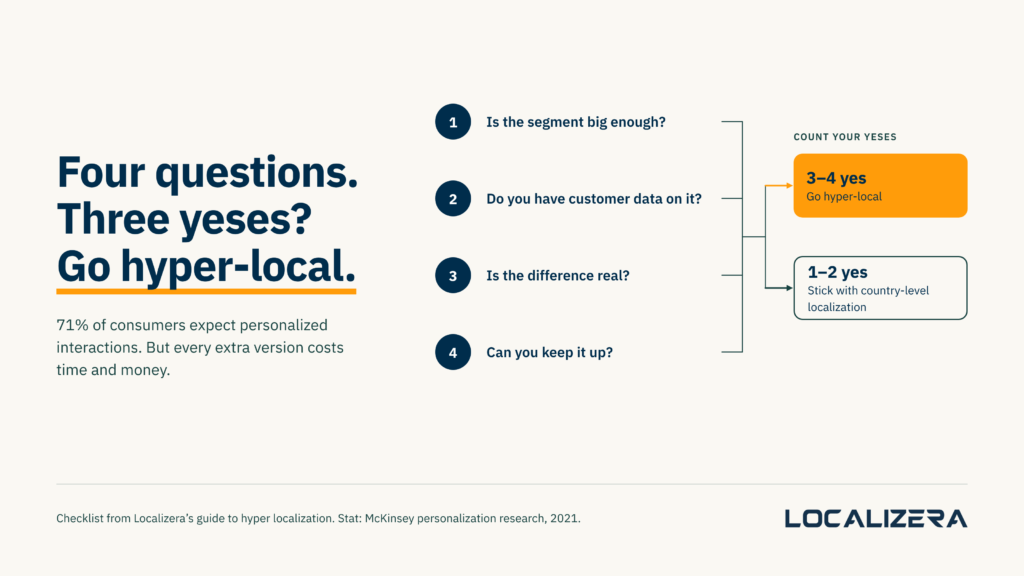
Short answer: often, but not always. People already expect brands to get personal. McKinsey’s 2021 personalization research found that 71% of consumers expect personalized interactions and 76% get frustrated when they don’t get them. It also found personalization usually lifts revenue 10-15%, with a company range of 5-25%. Hyper localization is personalization at the market level, so the same logic applies.
Still, every extra version costs time and money. Run this 4-question check first:
- Is the segment big enough? A city or region should be large enough, or valuable enough, to repay a separate version.
- Do you have customer data on it? Market segmentation should come from real behavior: where people buy, what they search, how they pay. Guesses lead to stereotypes.
- Is the difference real? If Austin and Dallas respond the same way, one version will do. Look for real gaps in dialect, habits, or holidays.
- Can you keep it up? Local slang and trends move fast. Make sure you have the budget and the people to refresh versions over time.
Three or four yes answers? Go hyper-local. One or two? Stick with solid country-level localization for now. Experienced localization service providers can help you size each market before you commit.
How to Start With Hyper Localization
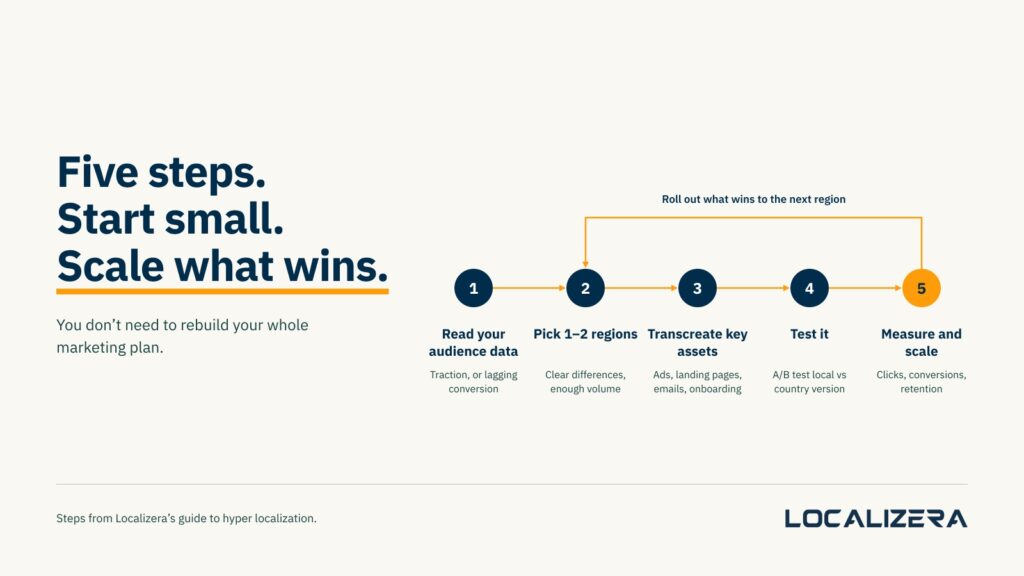
You don’t need to rebuild your whole marketing plan. Start small and learn fast.
- Read your audience data. Find the cities or segments where you already see traction, or where conversion lags.
- Pick 1-2 regions. Choose places with clear cultural differences and enough volume to measure.
- Transcreate key assets. Focus on high-impact pieces: ad headlines, landing pages, emails, app onboarding. Our cultural adaptation services help here, from cultural references to local imagery.
- Test it. Run A/B testing of the local version against your country version in the same campaign.
- Measure and scale. Track clicks, conversions, and retention. Roll out what wins to the next region.
AI can draft regional variants quickly, and it’s changing translation services in 2026. Pair it with native linguists who live in that market, though. A tool can find a slang word. A local knows if it’s still cool.
Hyper Localization FAQ
What does hyper localization mean?
Hyper localization means adapting content for a specific city, region or audience segment inside a country, not just for the country or language. It uses local slang, cultural references, imagery, holidays, and payment methods so the content feels like it was made by someone from that place.
What is an example of hyper localization?
Netflix offers separate Spanish audio for Spain and for Latin America, so viewers hear their own regional dialect. Another example is a delivery app that writes different Spanish ad copy for Mexico City, Madrid, and Miami, each with its own slang and local habits.
Is hyperlocalization the same as hyperlocal marketing?
No. Hyperlocalization adapts language and culture for a narrow audience, wherever that audience is online. Hyperlocal marketing targets people near a physical location, such as “near me” searches and geo-targeted ads, to bring in foot traffic. Many brands use both together.
How much does hyper localization cost compared with localization?
It costs more because you create and maintain extra versions for each segment. The amount depends on how many regions, assets, and languages you cover. Keep costs in check by starting with 1-2 regions and a few high-impact assets, then scaling only what performs.
Ready to Feel Born Local?
Hyper localization turns “we translated it” into “they get us.” With 10+ years in the game, 26K+ language experts and 260+ languages, Localizera is the localization agency that helps your brand sound local in every city that matters.