
Picture this: your product launch video goes live in Spanish. The synthetic voice sounds smooth, the lip sync is close enough, and then a customer in Madrid points out that your product name was pronounced like a breakfast cereal. In front of 40,000 viewers.
That’s the gap nobody mentions on tool landing pages. So here’s the straight answer: the best AI video translator for business depends on the video. AI-only tools are fine for internal or short-lived content, but customer-facing videos usually need AI plus human review to get brand terms, tone, and timing right. For ads and high-stakes content, full human dubbing still gives the most natural result.
Why bother at all? Because language still decides who buys. In a 2020 CSA Research survey of 8,709 consumers in 29 countries, 76% said they prefer to buy products with information in their own language. Video is no exception. Below, we compare the three ways to get there, with a table, a real-world style before-and-after, and a decision guide by video type.
TL;DR
- The best AI video translator for business is really a choice of workflow, not one tool.
- AI-only: great for internal and short-lived videos. Fast, low cost per minute, but brand terms, jargon, and idioms slip through.
- AI plus human review: the sweet spot for demos, webinars and customer training. AI speed, human accuracy.
- Full human dubbing or voiceover: still the winner for ads, launches, and anything that has to sell emotion.
- Cloning a speaker’s voice? Get written consent. Publishing in the EU? Plan for AI disclosure under the EU AI Act.
How AI Video Translation Tools Work
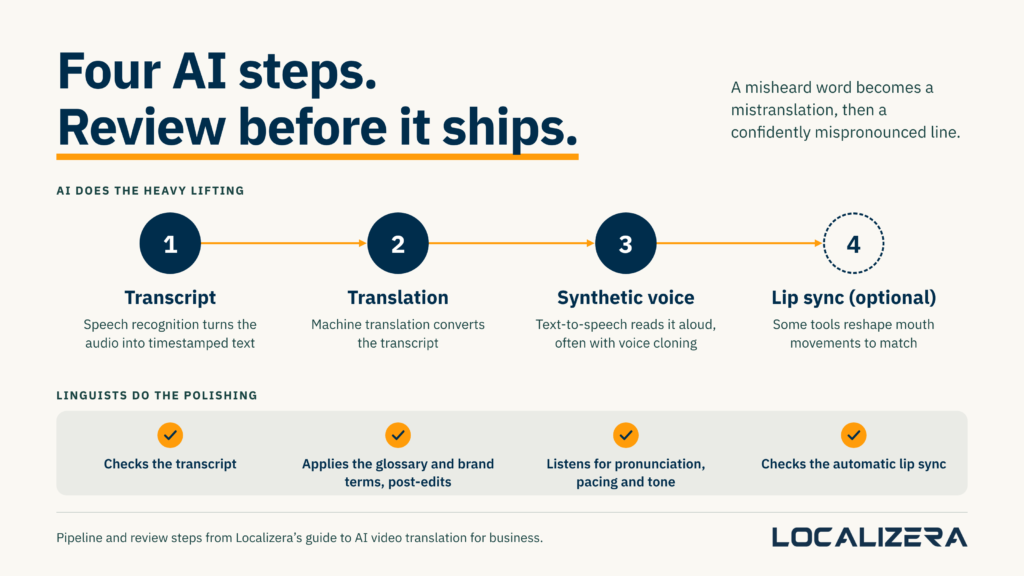
Most AI video translation tools run the same four-step pipeline:
- Transcript. Speech recognition turns the original audio into text, with timestamps.
- Translation. Machine translation converts that transcript into the target language.
- Synthetic voice. A text-to-speech engine reads the translation aloud. Many tools add voice cloning, so the new track sounds like your original speaker.
- Lip sync (optional). Some tools reshape mouth movements to match the new audio.
Every step can go wrong in its own way. A misheard word in the transcript becomes a mistranslation, which becomes a confidently mispronounced line. And not every video needs a voice at all. Sometimes video subtitling is the smarter, lighter option. If you’re weighing that route, our guide on AI captions vs human subtitles breaks it down.
One more thing to know before you hit “translate”: localization is bigger than words. Kyle Odefey, a video producer at Synthesia, points out that on-screen graphics, date formats, idioms, and cultural references may also need adapting, and that translated text often runs 10–30% longer than English. That matters when your on-screen labels suddenly don’t fit.
3 Ways to Translate Business Videos (AI Video Translation Tools, Hybrid, Human)
-
AI-only tools
This is the fully automated route: upload a video, pick languages, download dubs. Avatar and dubbing platforms like HeyGen and Synthesia sit here, along with built-in options like YouTube automatic dubbing, which generates translated audio tracks for eligible channels at no extra cost.
The upside is obvious: minutes instead of weeks, and a very low cost per minute. The downside is that nobody who speaks the target language checks the output before your audience does.
-
AI plus human review
Here, AI does the heavy lifting and linguists do the polishing. A human reviewer checks the transcript, applies your glossary and brand terms, handles post-editing of the translation, and listens to the final synthetic voice for pronunciation, pacing, and tone. This is how AI localization should work: machines for speed, people for judgment.
The industry is landing in the same place. As Jonny Stringer writes on the RWS blog, synthetic voices make video localization faster to scale, but linguists are still needed to check meaning, adapt for culture, and fine-tune emotional delivery. Our take: the hybrid model isn’t a compromise. For most business video, it’s the best of both.
Bonus for YouTube publishers: you don’t have to accept the auto-dub. YouTube lets creators upload their own dubbed audio as a multi-language audio track, so a reviewed dub can replace the robot version.
-
Human dubbing and voiceover
Professional voice actors, a dubbing director, and a studio. It takes longer and costs more, but nothing beats a human performance for humor, emotion, and persuasion. Need it for a launch or campaign? Our professional dubbing services cast native voices for each market. For simpler narration, a translated voiceover over the original audio is a lighter alternative.
Best AI Video Translator vs Hybrid vs Human
|
AI-only |
AI + human review |
Human dubbing |
|
|---|---|---|---|
|
Quality |
Good for clear speech; uneven across languages |
High; natural phrasing |
Highest; full performance |
|
Brand terms |
Often mispronounced or translated |
Locked in with a glossary |
Locked in, coached in studio |
|
Lip sync |
Automatic, sometimes uncanny |
Automatic, checked by a reviewer |
Timed by dubbing pros |
|
Speed/turnaround |
Minutes to hours |
Days |
Weeks |
|
Cost per minute |
Lowest |
Mid-range |
Highest |
|
Compliance & data privacy |
Depends on the tool’s terms; consent often unchecked |
Consent and disclosure checked in the workflow |
Talent contracts cover voice rights |
|
Best for |
Internal, short-lived content |
Demos, webinars, training at scale |
Ads, launches, brand films |
What Free AI Video Dubbing Gets Wrong
Free AI video dubbing is getting better fast, but even the platforms are upfront about the limits. YouTube’s own help page on automatic dubbing says:
- You can’t edit automatic dubs. If a line is wrong, your main fix is correcting the original language and letting the dub regenerate.
- Proper nouns, idioms, and jargon are hard. YouTube flags all three as known challenges.
- Quality varies by language. Results may not be the same across every language pair.
- Lip sync is experimental and only available to select channels.
Here’s what that looks like in practice. A sample line from a SaaS demo, translated into Spanish:
|
Version |
Line |
|---|---|
|
Original (EN) |
“Click Sync to Hub and your Q3 pipeline is ready to rock.” |
|
AI dub |
“Haz clic en Sincronizar con el centro y tu tubería del tercer trimestre está lista para rockear.” |
|
Reviewed fix |
“Haz clic en Sync to Hub y tu pipeline del T3 estará listo para despegar.” |
What the reviewer caught: the button name was translated even though the product UI is in English (a glossary rule), “pipeline” became a literal water pipe, and “ready to rock” turned into nonsense. Three errors, one sentence. Multiply that by a 20-minute webinar.
AI Video Dubbing and the Law: Consent, Disclosure and Deepfakes
This is where many teams get stuck, and for good reason. (Quick note: this is general information, not legal advice.)
- Voice consent. Voice cloning copies a real person’s voice. Get written consent from the speaker that covers which languages, which videos, how long, and whether the voice model is deleted afterward. Former employees and freelance presenters are the usual blind spots.
- Disclosure. Under Article 50 of the EU AI Act, providers of AI systems that generate synthetic audio or video must mark the output in a machine-readable way, and deployers must disclose content that counts as a deepfake, meaning realistic AI-made content showing real people. A cloned CEO speaking fluent Japanese can fall into that bucket. Check the European Commission’s guidelines for current application dates and scope.
- Data privacy. Uploading unreleased product footage or employee faces to a free tool means accepting its data terms. Read them, or use a workflow where you control where files go. RWS’s Stringer also flags voice ownership and data security as open questions, so this isn’t paranoia; it’s diligence.
Which Option Fits Your Video? An AI Video Localization Decision Guide
Use the video’s audience and lifespan to decide:
- Internal training, all-hands recaps, HR updates → AI-only. A quick spot check by a bilingual colleague is enough.
- Product demos, webinars, onboarding, help videos → AI video localization with human review. Customers see these, and every brand term counts. Our video translation services combine AI speed with native reviewers.
- Ads, brand films, launches, executive messages → human dubbing. Pair it with marketing translation services so scripts, captions, and landing pages all match.
Not sure where to start? We suggest testing with a few short, well-performing videos before scaling, which is solid advice whichever route you choose.
If you’re comparing localization service providers, look for one that does all three, so you’re not forced into one model for every video. That’s the point of working with a full localization agency like Localizera: 10+ years in the business, 7K+ clients, 26K+ language experts across 260+ languages, and a 98% satisfaction rate. Explore our full range of localization services. Curious about the wider shift? Read about how AI is changing the translation services industry in 2026.
Want the bigger picture? Read our take on the future of localization and how AI and automation are reshaping the industry.
FAQ
Can ChatGPT translate a video?
Not directly as a dub. ChatGPT can translate a transcript you paste in, and some versions can process audio, but it won’t produce a synced, dubbed video. You’d still need a transcription step, a voice tool, and video editing, so dedicated AI video translation tools or a service are faster for finished results.
Can I translate a video for free?
Yes, within limits. YouTube automatic dubbing is free for eligible channels, and many AI tools offer free trials with watermarks or minute caps. Free options work for quick tests and internal content, but you usually can’t edit the output, so errors in names and jargon stay in.
Is AI dubbing good enough for marketing videos?
For social clips and quick tests, sometimes. For paid ads, launches, and brand campaigns, usually not on its own. Marketing depends on tone, humor, and timing, which is where synthetic voices still slip. AI plus human review closes most of the gap; full human dubbing closes all of it.
Do I need permission to clone a speaker’s voice?
You should always get it. A voice is personal data in many jurisdictions, and using one without consent creates legal and reputational risk. Get written consent covering languages, uses, and duration, and check disclosure rules such as the EU AI Act wherever you publish.
Ready to Make Your Videos Feel Born Local?
Whether you need fast AI dubs, a reviewed hybrid workflow, or full studio dubbing, we’ll match the method to the video.