

Your checkout button says “Add to cart.” In German, it’s “In den Warenkorb legen,” and that neat little button just bursts at the seams. Now multiply that by five languages, 400 strings, three file formats, and a launch date your CEO already announced on LinkedIn.
That’s where localization project management earns its keep. It’s the planning and coordination that takes content from source files to finished, tested versions in every target language, on time and on budget. A project manager scopes the work, prepares files and glossaries, assigns linguists, runs quality checks, and delivers each language, while you review and approve.
This guide shows the buyer’s side: what happens, who does what, how long it takes, and what you hand over.
TL;DR
- What it is: localization project management coordinates translation, file engineering, QA, and testing so every language ships on time and on budget.
- How it runs: a 7-step localization process, from scope and quote to delivery and sign-off.
- How long: a 20-page website into 5 languages takes about 3–4 weeks.
- Your part: editable files, an approved glossary, fast reviews, and one named approver.
- Watch for: vendors who skip the glossary, the second reviewer, or in-context review.
What is localization project management?
Translation turns words into other words. Localization makes a product feel born local: the right date formats, currency, imagery, and tone, plus a UI that doesn’t break. Localization project management is the discipline that keeps all of those moving parts in sync.
At Localizera, one dedicated PM owns your project from kickoff to sign-off. They’re your single point of contact. Behind them sits vendor management: matching the right linguist and reviewer to each language from our network of 26K+ language experts, booking capacity, and keeping turnaround promises honest.
A good PM balances scope, budget, and time. Change one and the other two move, and your PM tells you before it happens, not after.
If you’re comparing localization service providers, the PM is the person you’ll talk to most, so size them up early.
Localization vs. translation project management: same words, bigger job
Translation project management handles words. A document goes in, a translated document comes out, and the PM tracks word counts, deadlines, and translator assignments.
Localization project management handles everything around the words too: files, UI strings, images, layouts, functional testing, and market fit. Here’s the difference in two lines of copy:
Source (US English) | Translated only | Localized (German) |
|---|---|---|
Ships 11/07/2026 | Versand am 11/07/2026 (a German reader sees July 11) | Versand am 07.11.2026 |
Add to cart | In den Warenkorb legen (overflows the button) | In den Warenkorb, checked in context so it fits |
Translation project management would ship the middle column. Localization PM catches it, because someone tested the screen. For apps and platforms, that’s what software localization adds.
The localization process in 7 steps
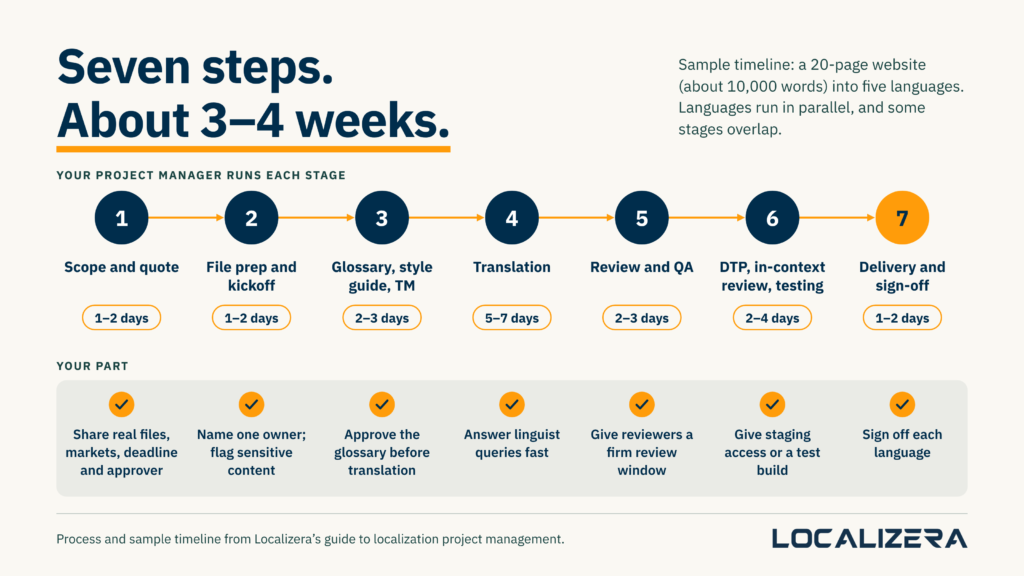
Every vendor tweaks the details, but a solid localization process follows the same backbone. Here’s ours, with what you’ll be asked for at each stage.
1. Scope and quote
Your PM reviews the content, file types, languages, and word counts, then sends a quote and timeline. Translation memory matches lower the cost.
Your part: share the real files (not screenshots), your target markets, the deadline, and who signs off.
2. File prep and kickoff
Engineers pull text out of source formats (JSON, XLIFF, HTML, InDesign) into a CAT tool or TMS. File prep is where hard-coded strings and text baked into images show up. A short kickoff call then aligns scope, tone, and dates.
Your part: name one owner on your side and flag anything legally sensitive.
3. Glossary, style guide and translation memory
The termbase lists product names and words that stay in English. The style guide sets tone, formality (German du or Sie?) and punctuation. Translation memory stores approved sentences so you never pay twice for the same line. The international standard for translation services, ISO 17100, treats this prep and a second-person revision as core to a professional process.
Your part: approve the glossary before translation starts. Thirty minutes here saves days later.
4. Translation
Linguists translate in the CAT tool, with the glossary and memory built in. For high-volume or lower-risk content, we may suggest machine translation with human review to cut cost and time. Enterprise teams with compliance needs can go further with an LLM-powered localization workflow.
Your part: answer linguist queries fast. Every open question is a stalled language.
5. Review and QA
A second linguist revises every translation, and automated QA checks numbers, tags, terminology, and length. We score quality with MQM, which sorts errors into categories like accuracy, fluency, terminology, and style, each rated minor, major, or critical. You get a number, not a vibe.
Your part: if you have an in-country reviewer, give them a firm review window.
6. DTP, in-context review and testing
Text grows in translation: W3C’s internationalization guidance on text size shows short strings can expand two to three times. DTP fixes layouts, in-context review checks every string on the real screen, and functional testing makes sure nothing breaks. Our LQA services cover this stage end to end.
Your part: give us staging access or a test build.
7. Delivery, sign-off and updates
Files come back in their original format, ready to import. You sign off each language, and the translation memory is updated, so next release only new strings go through.
Your part: sign off per language and give your PM a heads-up on the next release.
AI in localization project management: faster, not hands-off
AI now drafts, checks, and sorts content faster than any human team. The PM’s job is deciding where it earns its place and where people stay in charge.
Content type | Typical route |
|---|---|
Help articles, product catalogs, internal docs | MT or LLM draft + human post-editing |
UI strings | AI draft + glossary-locked terms + in-context review |
Marketing, slogans, brand voice | Human translation or transcreation |
Legal, medical and regulated content | Human translation + revision; AI for QA checks only |
Why humans stay in the loop: “Our new app is a game changer” came out of raw MT as “Unsere neue App ist ein Spielveränderer,” a word no German would say. Post-edited, it became “Unsere neue App verändert alles.”
AI also helps on every project behind the scenes: flagging terminology mismatches, catching missing tags and numbers, and pre-scoring quality so reviewers focus on risky segments.
Before you switch it on, ask your PM three things: which engine your content goes through, whether your data is used for training, and what MQM score counts as a pass. Post-editing even has its own standard, ISO 18587, separate from ISO 17100.
Sample localization project timeline
Here’s a typical localization project: a 20-page website (about 10,000 words) into five languages. Languages run in parallel, and some stages overlap.
Stage | Typical days |
|---|---|
1. Scope and quote | 1–2 |
2. File prep and kickoff | 1–2 |
3. Glossary, style guide, TM | 2–3 |
4. Translation | 5–7 |
5. Review and QA | 2–3 |
6. DTP, in-context review, testing | 2–4 |
7. Delivery and sign-off | 1–2 |
Total | About 3–4 weeks |
Your PM confirms the real schedule at the quote stage. The biggest variable is usually how fast your reviews come back.
Before you start a localization project: your checklist
Gather these and your kickoff will be smooth:
- Source files in an editable format
- Target languages and locales (Mexican Spanish and Castilian Spanish aren’t the same market)
- Deadline and launch order
- A budget range
- Any existing glossary, style guide, or translation memory from a previous vendor (it’s yours, so ask for it)
- Examples of your brand voice
- Staging or test environment access
- One named approver per language
- A quick internationalization check: strings pulled out of the code, and a UI that can handle longer text and right-to-left scripts
Not sure what’s in scope yet? Our localization services page breaks down what we cover.
What research says about localization project management
In their 2022 article in the L10N Journal, Marián Kabát and Mária Koscelníková point out that “localizer” is a slippery job title. Used broadly, it covers localization engineers, managers, editors and testers, plus the developers and designers who adapt code and visuals. That’s exactly why a project needs someone coordinating the whole team.
They also note that treating translation as an add-on after the product was finished proved impractical, which is why localization moved into development from the start. Their recurring headaches will sound familiar: text too long for the interface, and hard-coded strings that need a developer. And because scope varies with the project, team size, and budget, there’s no one-size process.
From a practitioner’s angle, see Arabize’s paper on localization project management. Arabize, founded in Cairo in 1994, was one of the first localization companies in the Middle East and North Africa. Arabic is a great stress test for any PM: mirrored layouts, mixed right-to-left and left-to-right text, and font support all need extra DTP and review time.
Our takeaway for buyers:
- Bring your vendor’s PM in before you freeze the design.
- Budget extra testing for right-to-left and long-text languages like German.
- Fix hard-coded strings early; it’s the cheapest bug you’ll ever squash.
Red flags in a vendor’s localization project management
A good localization agency will make the process feel almost boring. Watch out for these:
- No questions at the quote stage
- No glossary or style guide step
- The same person translates and “reviews” their own work
- No in-context review or testing for software and websites
- A vague timeline with no milestones
- They can’t say who your linguists are or who owns your translation memory
- Radio silence until delivery day
FAQ
How long does a localization project take?
It depends on volume, languages, and file types. A 20-page website into five languages typically takes three to four weeks. Smaller updates often take just days, because translation memory reuses approved text. Your PM sends a dated schedule with the quote.
What does a localization project manager do for the client?
They’re your single point of contact. They scope the work, prep files, build the glossary and style guide, brief linguists, run QA and testing, and deliver each language. They also flag budget or deadline risks early, so you decide with the facts in hand.
What files do I need to provide?
Editable source files: JSON or XLIFF for software, HTML or CMS exports for websites, InDesign or Word for documents. Add any existing glossary, style guide, or translation memory, plus brand voice examples. Screenshots or a staging link give linguists the context they need.
Do I need a translation management system (TMS) to start?
No. Your vendor runs the TMS and CAT tools, so you can simply send files. A TMS pays off once you localize continuously, like frequent app releases, because it can connect to your code repository or CMS and pull new strings automatically.
Ready to feel born local?
It pays off: a 2020 CSA Research survey of 8,709 consumers in 29 countries found 75% are more likely to buy again when customer care is in their language. Localizera brings 10+ years, 7K+ clients, 260+ languages, and a 98% satisfaction rate, with offices in Warsaw and Orlando.