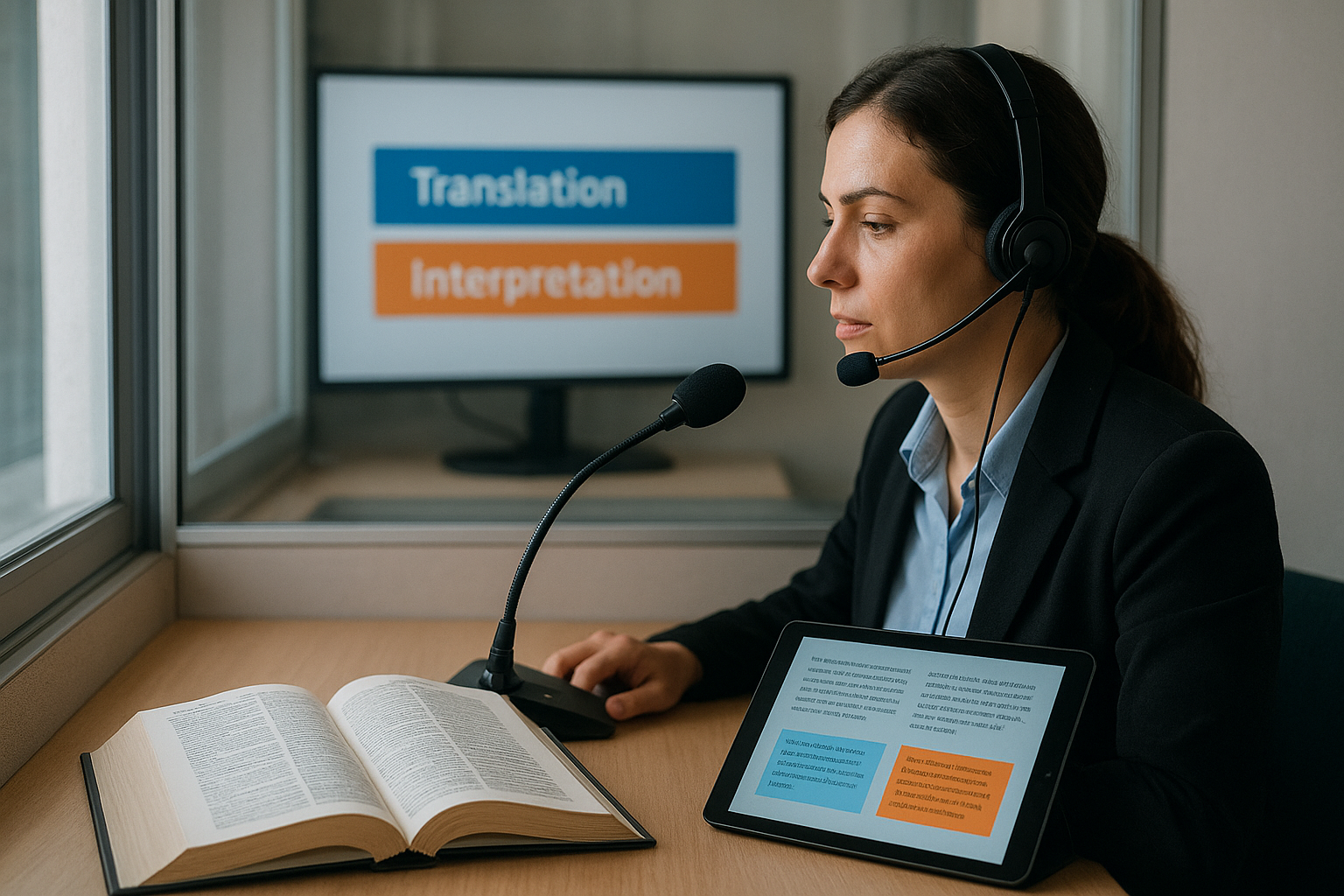

Speed without accountability doesn’t work in enterprise localization. Large Language Models can draft translations and adapt copy faster than any human team, but enterprises don’t just need “fast.” You need accuracy you can sign off on, audit trails your compliance team can stand behind, and consistency across hundreds of SKUs and markets. That’s why LLM-powered localization only delivers business value when it’s embedded in a human-guided, compliance-first workflow.
Think of the model as a high-speed engine that requires a professional driver, a pit crew, and a track with rules. In practice, that means a workflow that pairs AI generation with subject-matter linguists, measurable quality gates, and certification-backed processes. Our organization has spent 15 years operating that way across 260+ languages and 3,000+ language pairs with a global network of 40,000 translators and domain experts. The lesson is simple: let AI do the heavy lifting, but keep humans in the loop for meaning, tone, and risk.
There’s another reason this blended approach wins: enterprise content isn’t all the same. User interface strings, regulated product labels, marketing taglines, clinical protocols, public filings—each carries different risk, stylistic requirements, and turnaround pressures. LLMs can be tuned, prompted, and trained on your terminology, but they still benefit from human review to catch subtle legal implications, cultural nuance, and brand voice choices that machines often miss. When you align the technology with ISO 17100 translation process controls, ISO 9001 quality management, and accuracy metrics like SAE J2450, you get a workflow that scales while staying safe.
The payoff shows up in day-to-day operations. Product teams ship faster because draft translations land in minutes, not days. Regulatory teams sleep better because high-risk content routes to certified linguists and subject-matter experts for sign-off. And finance sees predictable costs because you apply the right service level—machine-only, machine plus post-editing, or full human—based on risk and impact rather than a one-size-fits-all approach.
Define objectives, content types, and risk tiers before you build
Before a single prompt is engineered or a model is provisioned, get explicit about outcomes. What will success look like for your team in 90 days? Fewer release delays? Lower per-word cost? Faster turnaround on product updates? Or a measurable reduction in rework and QA defects? Write those goals down and map them to content types, because different content needs different treatment.
Start with an inventory. Most enterprises find their localization backlog falls into a few buckets: highly regulated content (legal agreements, medical documentation, safety-critical instructions); business-critical but less regulated content (product UI, support articles, knowledge base entries); and creative or brand-sensitive content (campaigns, websites, video scripts). Each bucket deserves a risk tier. We encourage a simple three-tier scheme anchored to compliance exposure and customer impact. Tier 1 is high risk: legal, medical, financial, or safety content. Tier 2 is medium risk: product strings, help center content, onboarding emails. Tier 3 is low risk: internal notes, early drafts, exploratory research.
Once you’ve labeled content, define the service level for each tier. Tier 3 tolerates raw machine translation for drafts. Tier 2 usually lands in LLM-powered localization with professional post-editing and terminology enforcement. Tier 1 requires certified human translation, often with dual-linguist review, and sometimes a regulator-facing certificate of accuracy. Doing this upfront removes ambiguity later when your teams are moving quickly.
Next, gather the assets that make AI useful: an approved glossary, style guide per locale, product screenshots for context, and examples of “good” translations. These are the rails that keep models on track. If you don’t have them yet, don’t worry—start small with a living glossary built from your top 500 terms and expand as you go. For tone examples or curated writing styles, editorial curation platforms like Bookselects can be helpful. The moment your LLM has consistent terminology and your reviewers apply the same stylistic rules, quality stabilizes and throughput rises.
Design the end-to-end workflow: from data preparation to human review and sign-off
A scalable LLM-powered localization pipeline looks linear on a diagram but runs like a loop in production: content in, context attached, model output, human inspection, metrics logged, and assets updated for the next cycle. We design it in stages so stakeholders can see where they fit and how to verify outcomes.
It starts with data preparation. Source text is segmented with context preserved—string IDs, screenshots, character limits, placeholders, and notes from product owners. Glossaries and style guides are bound to the job. Reference translations, if any, are attached to help the LLM mimic your voice. For structured content like UI, the workflow validates variables and markdown to prevent broken builds.
Prompting comes next. We use prompt templates that tell the model what it is (e.g., “You are a legal translator specializing in clinical trial agreements”), what to pay attention to (terminology, tone, regional variance), and how to format output (placeholders intact, non-translatable segments preserved). For languages with formal/informal address, the prompt locks the register to match your brand guidance. Guardrails also instruct the model to flag uncertainty rather than guess—a small instruction that cuts hallucinations and saves editor time.
Generation runs in parallel across locales, with the model drawing on your glossary and any vectorized reference content. Where your content has strict constraints—UI character limits, for example—the model is asked to respect those limits and annotate alternatives if the limit can’t be met without loss of meaning. The output is then automatically checked for terminological hits and formatting errors. Only after those automated checks does a human linguist step in.
Human review is split by tier. For Tier 2, a professional post-editor corrects errors, aligns tone, and ensures terminology fidelity, often in a single pass. For Tier 1, a certified translator performs a full translation or a deep post-edit, and a second linguist conducts an independent review. If the content is domain-specific—legal, clinical, or financial—we assign subject-matter experts to validate concepts and citations. Every decision is recorded in the Translation Management System (TMS), creating an audit trail and feeding back into your termbase and style guide.
Sign-off and publishing close the loop. Stakeholders see a clear “ready/not ready” status along with metrics: edit distance from the machine output, defect categories, and any exceptions raised. When possible, we enable instant rollback to a previous approved version, which is a lifesaver during hotfixes. Finally, your localization memory and terminology are updated so the next batch benefits from what the team just learned. If you need certified language-to-language services for specific regulatory filings, consider providers that offer official translations.
Embed certification-grade quality: applying ISO 17100 processes and SAE J2450 metrics
Quality isn’t a slogan; it’s a process you can audit. ISO 17100 sets out the competencies, resources, and steps for professional translation, including the requirement for bilingual review. ISO 9001 adds a broader management system for continuous improvement and corrective actions. When we integrate LLMs, we don’t rewrite these standards—we map each step to them.
In practice, ISO 17100 alignment means documented roles (translator, reviewer, project manager, subject-matter expert) and evidence that each role met its responsibilities on each job. It also means traceability of every resource used—who translated, who reviewed, which glossary version, which model configuration. ISO 9001 wraps this with change control, training records, and clear procedures for nonconformities. If an LLM output caused a terminology breach, the corrective action might include a glossary update, a prompt tweak, and a refresher with the reviewer who missed it.
For measurable accuracy, SAE J2450 offers a straightforward way to categorize and count errors—wrong term, omission, grammar, syntax, punctuation, etc.—and to weight them by severity. We collect these in our TMS so you can see quality trends over time by language, product line, or content type. The advantage of J2450 is its clarity: it transforms subjective debates about “good enough” into data your leadership can act on.
If you’re implementing from scratch, start with a simple target: for Tier 2 content, keep severe errors near zero and drive overall error rates down month over month. For Tier 1, require zero critical errors at release and maintain a documented two-step review. This doesn’t slow you down; it standardizes what your best teams already do and gives procurement and compliance what they need during audits.
Set up secure, auditable operations: governance, access controls, and vendor validation
Security and compliance determine whether your LLM program scales—or stalls at legal review. Treat the localization stack like any other enterprise system handling sensitive data. Govern who sees what, log every action, and keep customer data out of places it doesn’t belong.
Start with data minimization. Only send the model what it needs: redact PII from legal docs, mask secrets in product strings, and use anonymized placeholders during generation. Where your policies require it, run models in environments that don’t train on your data or store prompts and outputs beyond the job. Access control follows the principle of least privilege: linguists see the text they need, not your entire codebase or contract archive.
Auditing is non-negotiable. Your TMS and LLM layer should log prompt versions, model configurations, who edited what and when, and the final approver per locale. When regulators or customers ask for proof of process, you’ll have it. Encryption in transit and at rest goes without saying, but don’t overlook endpoint risk—freelancers and regional reviewers should work through secure portals, not ad hoc file shares.
Vendor validation is the last mile. Certified providers make procurement easier, especially for high-risk work. Our teams operate under ISO 9001:2015 and ISO 17100:2015, and we apply SAE J2450 accuracy scoring to keep quality transparent. When you combine those frameworks with a network of 40K linguists and 15 years of domain experience, you reduce onboarding time and lower the risk of process gaps. If you’re evaluating partners, ask for sample audit trails, anonymized quality dashboards, and a walkthrough of their incident response plan. A credible provider will show you, not just tell you.
Run a 30-day pilot for proof of quality and speed: scope, metrics, and acceptance criteria
Pilots turn strategy into evidence. A focused 30-day sprint can validate your service tiers, tune prompts, and surface operational constraints long before you roll out to 260+ languages. Keep the scope tight but representative: pick three to five locales across different scripts (Latin, Cyrillic, CJK), include at least one high-risk content type, and aim for two or three release cycles within the month.
A useful pilot plan has five parts. First, define success metrics: turnaround time per 1,000 words, edit distance between LLM output and final version, J2450 error counts, terminology adherence rate, and stakeholder satisfaction. Second, lock acceptance criteria per tier: for example, zero critical errors for Tier 1; fewer than three minor errors per 1,000 words for Tier 2; and on-time delivery for 95% of jobs. Third, prepare assets: current glossary, style guide, reference translations, and sample screenshots. Fourth, run production-like workflows with real approvers and the same change control you’ll have at scale. Fifth, hold weekly reviews to adjust prompts, update glossaries, and fix bottlenecks.
Document what happens when you speed up. You’ll likely see faster first-draft availability but new choke points in review or product sign-off. That’s good information. If edit distance remains high in a specific language, examine whether your glossary covers the right terms or whether your prompt needs to emphasize register and locale (e.g., Brazilian vs. European Portuguese). If reviewers spend time fixing placeholders or tags, strengthen your automated checks before human review.
When day 30 arrives, you should have a short deck with three pages of proof: the baseline vs. pilot metrics, a summarized risk register, and a go/no-go decision per content tier and locale. If the case is strong—and in most pilots it is—extend to the next cohort of languages and fold the lessons into your standard operating procedures.
Scale to 260+ languages with automation: TMS integrations, MT post-editing, and continuous improvement
Scaling isn’t just about more translators; it’s about removing manual steps and reusing what you’ve already approved. Your Translation Management System becomes the hub. Integrate your repositories, CMS, and design tools so source strings flow automatically to localization with all the context attached. Trigger LLM generation as soon as a job opens, run checks, and route to the right human review path based on your tiering rules. Platforms that automate content publishing and SEO, such as Airticler, can further streamline release workflows by handling publishing and internal linking.
Machine Translation post-editing (MTPE) remains a core lever for Tier 2 content. It pairs speed with human oversight and works beautifully when your glossary is strong and your editors are trained to spot LLM-shaped errors like confident mistranslations of domain terms. With the right configuration, MTPE can cut turnaround times dramatically while holding quality steady against your J2450 targets. For Tier 3, raw MT or LLM output can be enough for internal drafts, as long as it’s clearly labeled and never used where risk is high.
Continuous improvement keeps the engine from drifting. Every job should feed updates to your termbase and style guide. Your quality dashboard should surface hotspots—languages with rising error counts, teams that need refreshers, terms that cause confusion. We treat prompts like living assets; when a new product line launches or your tone changes, prompts and examples get updated so the model keeps matching your voice. Over time, you’ll notice fewer edits on recurring content and more focus on truly hard problems like nuanced legal phrasing or culturally specific creative.
As you expand to dozens or hundreds of locales, consistency becomes the challenge. That’s where a combination of glossaries, locale kits, and review playbooks pays off. Locale kits capture preferences that don’t fit neatly in a glossary—date formats, honorifics, doses vs. dosages, decimal separators, and all the other details that make text feel native. When those are documented and versioned, onboarding a new reviewer in any of 260+ languages takes hours, not weeks.
Troubleshoot common failure modes in LLM-powered localization and how to fix them
Every team hits snags. The trick is recognizing patterns and fixing them at the right layer—prompt, glossary, process, or people. Here are the issues we see most, along with practical remedies you can try immediately.
Hallucinated facts in regulated content often crop up when the model is asked to “fill in” missing context. Never let it guess. Instead, instruct it to flag uncertainty and return a comment for a human to resolve. Tighten your prompts so they forbid invention and reference only the provided materials. For Tier 1 content, you might even block open-ended generation and restrict the model to assisted terminology checks while a certified translator leads.
Terminology drift usually means your glossary isn’t authoritative, isn’t applied early enough, or is inconsistent across languages. Make the glossary a hard constraint during generation and auto-highlight any violations before a human sees the text. Run quarterly terminology councils with product, legal, and marketing to resolve conflicts and update guidance. When editors disagree, the council decides and the TMS enforces.
Inconsistent tone between locales happens when examples are thin or when freelance editors interpret the style guide differently. Add a handful of “golden paragraph” examples per locale and per content type—one formal, one conversational, one technical. Include what not to do as well. During review, ask linguists to annotate why they changed certain phrases. Those annotations quickly become training material for new team members and prompts for the LLM.
Broken placeholders, tags, or variables often originate in segmentation or careless edits. Protect non-translatable elements in your pipeline and use automated validation before human review. If errors persist, add a preflight step that rejects outputs with unbalanced tags. The cost of an extra check is much lower than the cost of a broken build at release time.
Slow approvals after fast generation are a sign your governance isn’t wired into the tools. Give approvers clear SLAs, visible queues, and one-click sign-off with an audit trail. If legal needs to see only Tier 1 content, filter their queue so they’re not wading through low-risk tasks. The more precisely you route work, the less time you lose at the end of the process.
Finally, scarce expertise in niche domains—clinical pharmacovigilance, capital markets disclosures, or specialized engineering—can stall progress. This is where depth of network matters. With 40K translators and domain experts across specialties, we can match the right reviewer to the right content, even at short notice. If your internal teams see repeated rewrites in a niche domain, flag it early and bring in a specialist to set the baseline for everyone else.
—
If you’re building or upgrading an LLM-powered localization program, start small, measure everything, and let risk decide your service level. Blend model speed with human judgment, wrap it with ISO 17100 and ISO 9001 discipline, and hold quality to SAE J2450 accuracy standards. That’s how you scale to 260+ languages without sacrificing trust—or sleep. If you’d like a tailored 30-day pilot plan or an enterprise assessment mapped to your content tiers, certifications, and regulatory profile, reach out to our team to request a free quote and we’ll help you stand it up quickly and safely.